As a travel and food writer, Nikki Bayley’s work has taken her through celebrated dining rooms, neighbourhood favourites, and global destinations. With pieces published in National Geographic Traveller, Times, Guardian, and Eater Vancouver, which Nikki launched and continues to write for today, her career in journalism has been highly celebrated. However, after nearly three decades of writing, Nikki has found herself on the other side of the story, trading her pen for a meat slicer and turning her attention towards something a little more tangible.
Enter Boards of Vancouver.
Like many of us working in creative fields, Nikki was faced with two rather significant hurdles within a short stretch of time. First came the pandemic, which presented an obvious challenge for someone whose livelihood depended on travel, dining, and the hospitality industry. The second followed close behind in the form of artificial intelligence.
“I looked at ChatGPT when it first launched and I went, oh no. It's going to eat my lunch,” says Nikki.
Rather pacing the room wondering what to do, Nikki began looking for a new direction. Opening a shop briefly entered the conversation, although the general consensus amongst friends and colleagues suggested that shopkeeping was likely not the wisest move for someone who had never run a retail operation. Fortunately, close friend Chef Ryan Bissell proposed another angle for consideration.
“All you ever serve at home is cheese,” she recalls him teasing.
Surrounded by wineries in the Okanagan, where Nikki had been living for nearly seven years, he suggested that Nikki should put her food knowledge to work by launching a charcuterie business.
It made sense. Nikki already possessed an expert understanding of how people experienced food, and had spent years developing the relationships and industry knowledge that would make the venture possible. Moreover, it was something she could get off the ground without taking on the considerable expenses of a brick-and-mortar operation.
She rented kitchen space through an arrangement with a local Legion, exchanging monthly buffets for a reduction in rent, invested in a meat slicer, and hit the ground running.
By her own admission, that first year came with its fair share of struggles. But the business soon found its footing, and Nikki began working with wineries throughout the Okanagan. However, not long after things began to take off, she found herself contemplating another change of scenery.
After nearly seven years in the interior’s Similkameen Valley, Nikki found herself missing Vancouver. Along with a coastal yearning, an unfortunate tumble down the stairs resulting in several shattered toes and a lengthy recovery period brought another consideration into focus. She wondered what it might mean to be older or unwell in a place where accessing everyday necessities and healthcare was a considerable challenge. That thought was enough to prompt a decision. She sold her home, returned to Vancouver equipped with her newly established charcuterie expertise, and began building Boards of Vancouver.
The move back to Vancouver brought with it a fresh audience, and along with it, a few lessons in what people look for in a charcuterie spread. In the Okanagan, Nikki had become accustomed to preparing generous quantities. Guests valued abundance in the most literal sense, with boards piled high and plenty to go around. Vancouver, she discovered, was operating with a different set of expectations. Here, presentation carries a more significant weight. People want to photograph their food, ask questions, discover the names of the farms and producers behind the products, and enjoy a smaller selection of things with a focused intentionality.
Fortunately, Vancouver has no shortage of excellent suppliers. Working on a deliberately small scale means Nikki can be selective about what makes its way onto her boards, sourcing from local favourites like Benton Brothers, Oyama Sausage Co., and Bosa Foods, alongside many other independent producers.
That fine tuned approach has remained central to Boards of Vancouver. Nikki has little interest in building something so large that it becomes difficult to manage, preferring instead to retain the freedom to work with products she genuinely loves and take on projects that interest her. In many ways, that philosophy is reflected in the boards themselves.
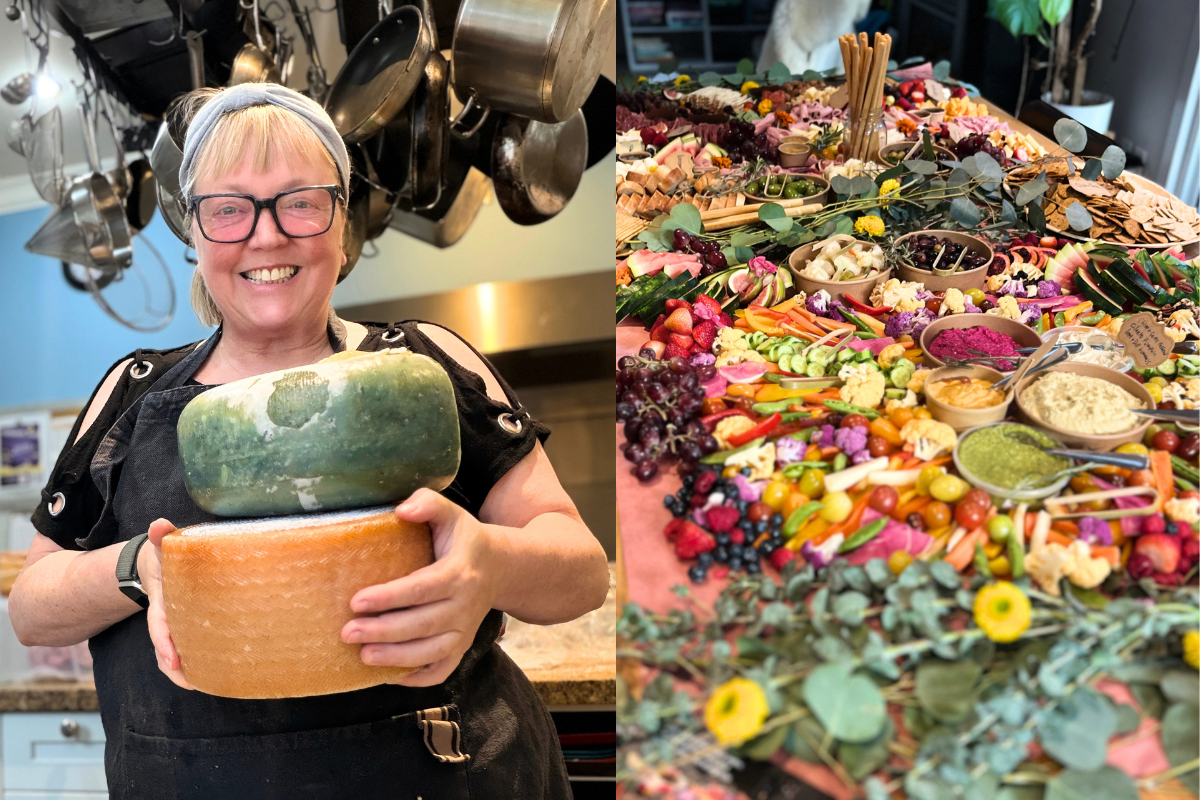
Nikki describes her guiding creative principle as “chaotic abundance”. It's an apt description for work that is intentionally free of rigid formulas or predetermined layouts. In fact, Nikki will tell you that she has never considered herself artistically inclined in a visual sense. She cites aphantasia: an inability to mentally visualise images, and has long struggled with the idea of planning something visually before bringing it to life. As a writer, this never posed challenges to the creative flow, but as Nikki soon discovered, aphantasia has a direct influence on her approach to charcuterie.
Somewhat unexpectedly, charcuterie has given her a new creative outlet. Rather than trying to achieve an aesthetically uniform delivery, Nikki embraces a freestyle approach. No two boards are identical.
“I want people to look at my work and just go, oh, there's so much of everything,” she explains.
There's another principle at play, however, and one that perhaps draws most directly from her years in journalism: “How are people experiencing this?”
As a travel and food writer, much of Nikki's work required a constant focus on guest experience, from entering a room, viewing a menu, taking the first bite, and all of the often overlooked details that fall in between. From here, she would distill her findings into recommendations that would help guide others towards genuinely enjoyable experiences. That process translates directly into her approach to charcuterie.
For example, most of her grazing spreads are prepared for social events. Nobody wants to fumble their way through chiseling at wedge of crumbly cheddar while trying to hold a conversation. As a result, everything is prepared to be enjoyed with ease. Cheeses are sliced, meats are ready to grab, and the entire spread is designed to make the experience as effortless as possible.
The latest chapter for Boards of Vancouver has brought Nikki into an entirely new kind of community. Having recently moved operations into the kitchen space at Friends for Life Society in Vancouver's West End, she's found a home that offers something considerably more meaningful than kitchen fixtures and room to work.
The foundation was established in the 1990s in response to the AIDS crisis, originally providing meals, community, and support services to those affected. Over the years, its programs have expanded to support people navigating a range of life-interrupting illnesses, including cancer, multiple sclerosis, and ALS. Today, Friends for Life offers a range of complimentary wellness services, from counselling and acupuncture to aromatherapy, reiki, yoga, and community meals.
For Nikki, the opportunity to become part of that ecosystem was an easy decision, and one that has come with ample opportunity. During the summer, Nikki ran a seven-week Sunday popup from the heritage space, serving up wine, charcuterie, and cocktails.
“We were literally dangling over the balcony going ‘we're selling wine, come and have wine!’” she remarks, noting that the tactic was highly successful in the neighbourly West End community.
In addition to donating 15 per cent of the proceeds from the popup, 100 per cent of her rent at the new space goes directly towards funding the foundation's initiatives.
Having experienced cancer within her own family and circle of friends, Nikki understands how much of a difference access to supportive care can make. While British Columbia is fortunate to have excellent medical treatments available, the additional services that can make navigating an illness considerably more manageable are not always accessible to everyone.
“How brilliant would it have been if something like this had existed for them?” she says. “How nice to be able to come and get counselling or aromatherapy or acupuncture or reiki. All those things that someone wealthy would be able to access, that if you're lower income and struggling with a life-interrupting illness and not working and have no money and you're scared. How nice to have somewhere to come”.
It's a particularly lovely arrangement, and one that seems to have found its footing with ease. Nikki gets to work in a beautiful heritage space, surrounded by people who are actively contributing to others’ wellbeing, while the foundation benefits from a tenant whose rent directly supports its programming.
She's already thinking about what might come next, with hopes of hosting long-table gatherings featuring an enormous charcuterie spread running down the length of the room.
While the work may have changed since her full time freelance days, Nikki's relationship with food certainly hasn't. What has changed is the way she's found to express herself within it. A career built around describing the experiences of others has evolved into one where she gets to create those experiences herself, one beautifully (and chaotically) abundant spread at a time. There's something rather fitting about a former food journalist finding a new creative language through cheese, and perhaps even more fitting that the result is something designed to bring people together.
Nikki's story is an excellent reminder that a change in direction doesn't necessarily mean leaving everything behind. Sometimes, the skills you've spent a lifetime developing are simply given new direction. And if there's a little cheese involved along the way, all the better.
For more food stories like this, check out our weekly newsletter.